


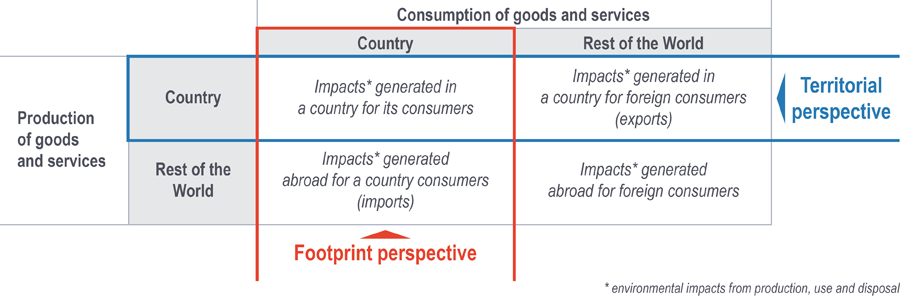
Traditionnal indicators at country level are territorial. They consider emissions or impacts occurring on the territory of a country, e.g. the domestic greenhouse gases emissions reported under the Kyoto Protocol.
Footprint indicators aggregate environmental impacts and/or resource uses along global production-consumption chains according to a life cycle perspective. They allow quantifying the environmental impacts induced by the consumption of the inhabitants of a country wherever these impacts occur on Earth.
Due to a growing international trade, a rising part of the environmental impacts on a territory is generated to satisfy consumers in other countries. For most developed economies, more than half of the environmental impacts induced by their consumption are thus induced elsewhere in the world.
MRIO models enable linking:
Look at the big picture !
Current results represent first estimates of the performances of countries with respect to Planetary Boundaries. Computations are based on international datasets included in world input-output models (WIOD and exiobase 2.0) which we complemented with additional sources and basic assumptions.
The overall perspective is assumed to be correct but errors could exist for specific countries. Results will be improved in the follow-up projects.